Huntsville’s space heritage began with a paperclip.
Operation Paperclip.
It was a secret American intelligence program in which more than 1,600 German scientists, engineers, and technicians were taken from Germany to the US for government employment after the end of World War II in Europe. Operation Paperclip was part of a broader strategy by the US to harness German scientific talent in the face of emerging Cold War tensions and ensuring this expertise did not fall into the hands of the Soviet Union or other nations.
In 1949, the Army designated Redstone Arsenal as the Ordnance Rocket Center, its facility for rocket research and development. A year later, Dr. Wernher von Braun and his team of more than 130 Paperclip members began work to develop the Redstone and Jupiter missiles, the precursors to the giant Saturn V rocket, which propelled Americans on the Apollo moon missions.
Then, things really took off. Catalyzed by the Soviet Union's launch of Sputnik 1 in 1957, the U.S. launched its first satellite, Explorer 1, in 1958 and officially created NASA. Fittingly, von Braun was named to head the fledgling Marshall Center, and Huntsville was transformed from a cotton town and “Watercress Capital of the World” to the “Rocket City.”
Then came the Mercury program. Sending Alan Shepard into space and John Glenn into orbit proved humans could survive in weightlessness. The Gemini program, which had two astronauts in each spacecraft, bridged the gap to lunar missions by developing crucial skills such as spacewalks and spacecraft docking. The astronauts rode Huntsville-made rockets into space.
To the moon
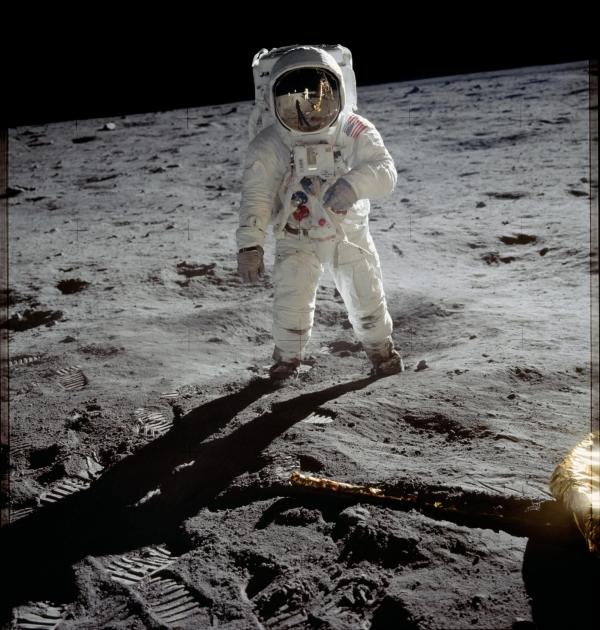
But the best was yet to come - the Apollo program and moon landings. To get humans to the moon, engineers had to design the most powerful rocket ever. And they did - at the Marshall Space Flight Center in Huntsville. Residents of Huntsville even took part in the testing of the massive engines when their homes shook, even cracking walls and foundations, as the rockets roared to life on the test stands at Marshall.
The testing paid off in 1969 when Neil Armstrong became the first human to walk on the moon. There were five more Apollo missions that landed on the moon, yielding unprecedented geological data and advancing rocketry. Following the lunar missions, NASA shifted focus to scientific observation and microgravity research in low Earth orbit. The nation’s first space station, Skylab, hosted three separate three-astronaut crews. The program was managed at the Marshall Space Flight Center.
To orbit and back
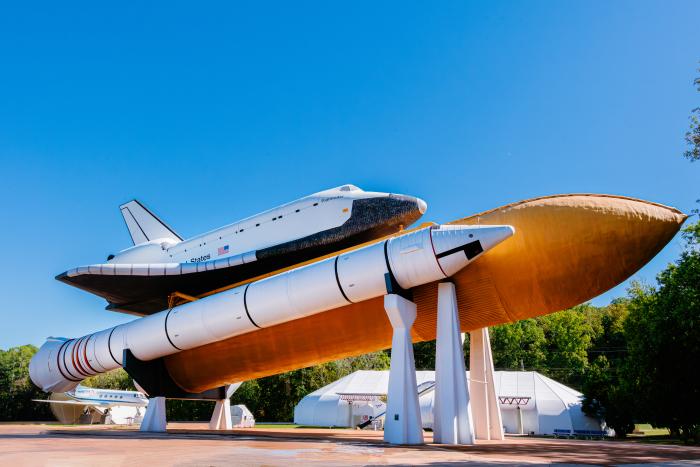
As the first reusable spacecraft to carry humans into orbit, the space shuttle fleet (Columbia, Challenger, Discovery, Atlantis, and Endeavour) completed 135 missions, launching like a rocket, orbiting as a spacecraft, and gliding back to Earth to land on a runway. The Marshall Space Flight Center was responsible for the spacecraft’s main engines, external tank, and solid rocket boosters. The shuttles deployed major observatories such as the Hubble Space Telescope and facilitated the construction of the International Space Station (ISS).
However, the program suffered tragic losses with the Challenger (1986) and Columbia (2003) disasters. After the Columbia disaster, NASA recognized the escalating maintenance costs and high risks of the shuttles. The fleet was officially retired in 2011, with the surviving orbiters finding their final homes as historical exhibits in museums across the United States. The U.S. temporarily relied on the Russian Soyuz spacecraft powered by Russian-built engines to transport astronauts to the International Space Station until the introduction of commercial spacecraft such as SpaceX's Crew Dragon in 2020
Back to the moon
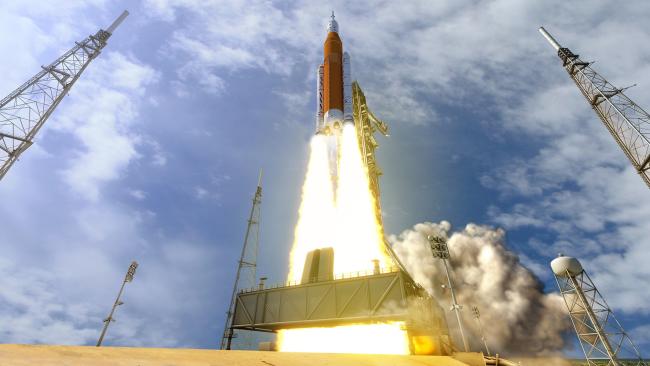
As the United States prepares to return to the moon and, eventually, Mars, once again, Huntsville finds itself on the front lines. The Artemis program is NASA's flagship initiative designed to establish a sustainable human presence on the Moon and pave the way for future crewed missions to Mars. Marshall manages the overarching Space Launch Systems program. Local companies teamed to build the Launch Vehicle Stage Adapter, and the Orion Stage Adapter is fabricated by NASA engineers. The engines are built by Blue Origin at its plant in Huntsville’s Cummings Research Park and tested on test stands at the Marshall Space Flight Center.
The Huntsville Operations Support Center at Marshall hosts twin control rooms. During flights, the Lunar Utilization Control Area handles Artemis science operations, and the Lander Engineering Support Area provides crucial engineering support. Marshall engineers are overseeing the development of the lunar landing system, which includes landers built by Blue Origin and SpaceX.
Up close and personal
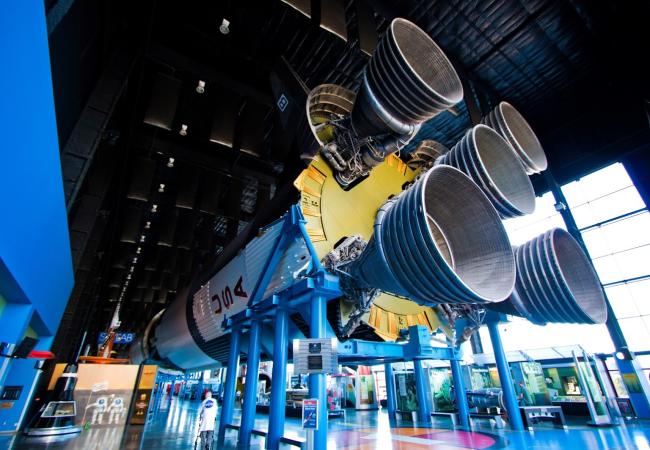
Huntsville also has a personal connection with the Artemis program. Frank Rubio, an astronaut on Artemis III, is a former flight surgeon stationed at Redstone Arsenal. If you want to get an up-close look at Huntsville’s space legacy, then a visit to the U.S. Space & Rocket Center is a must. With the iconic facsimile of a Saturn V rocket towering above it, the center is a Smithsonian Affiliate and the official NASA Visitor Center. It features one of the world's largest collections of space hardware, including a space shuttle test vehicle with a real external tank and boosters, an authentic Saturn V moon rocket, and displays related to the current Artemis program.
When you visit Saturn Hall, inside the Davidson Center for Space Exploration, you can walk under the Saturn V rocket. Visitors can stroll through the evolution of the U.S. space program in Rocket Park, an outdoor display showcasing towering historical rockets, aircraft, and spacecraft. And, to think, it all began with a paperclip.